07 January 2026
Findings published from LGBTQIA+ visible differences study
Following a recently conducted study into LGBTQIA+ young people with visible differences, The Centre for Appearance Research has now shared a summary of its findings.
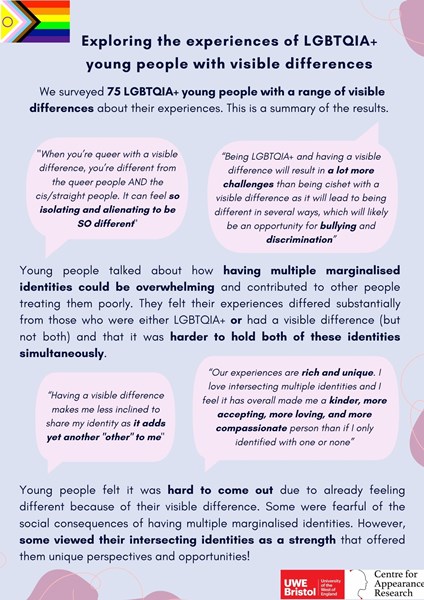
Researchers surveyed 75 young people and found that:
 Click to enlarge
Those with multiple marginalised identities (i.e. those that are LGBTQIA+ and have a visible difference simultaneously) can feel overwhelmed and poorly treated by others.
It can feel more difficult for young people to come out as LGBTQIA+ if they also have a visible difference – this can be due to already feeling ‘different’ or feeling fearful of social consequences.
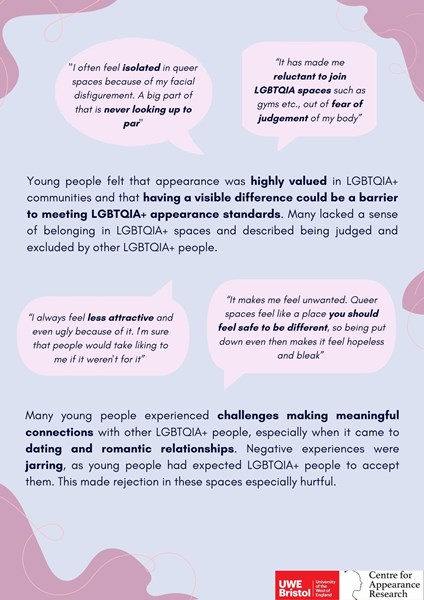
Appearance was highly valued in LGBTQIA+ communities – in these spaces, many young people lacked a sense of belonging and felt judged or excluded.
Participants were surprised to experience challenges when making connections with other LGBTQIA+ people, as they expected peers to be more accepting. This was especially prevalent with dating and romantic relationships.
 Click to enlarge
Most existing support resources for those with visible differences are tailored towards cisgender, heterosexual people – often ignoring the unique needs of LGBTQIA+ people.
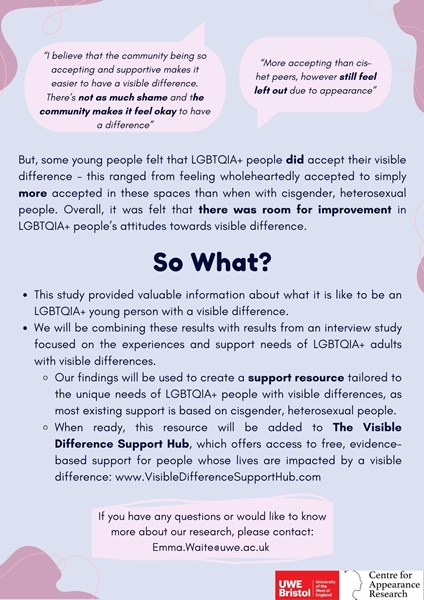
Conversely, some participants viewed their intersecting identities as a strength, providing them with unique perspectives and opportunities, and felt that they were more accepted by LGBTQIA+ peers than they were by cisgender, heterosexual peers.
Overall findings from the study concluded that there is room for improvement in LGBTQIA+ people’s attitudes towards visible difference.
 Click to enlarge
What happens next?
The findings of this study will be combined with results from a separate interview study focused on LGBTQIA+ experiences and support needs.
These will then both be used as part of a tailored support resource for LGBTQIA+ young people, which will be added to The Visible Difference Support Hub.
If you have any questions or would like to know more about this study, please contact Emma.Waite@uwe.ac.uk.