16 July 2026
Research findings revealed – Genetics and severe psoriasis
Data from a research project funded by the Psoriasis Association has been used in a recent study, showing genetics may be able to predict severe psoriasis and help ‘fast-track’ access to specialist care.
Researchers looked at nearly 45,000 people with psoriasis from a range of specialist groups and registries across Europe – this included data from ‘BSTOP’, a study that received critical early funding from the Psoriasis Association.
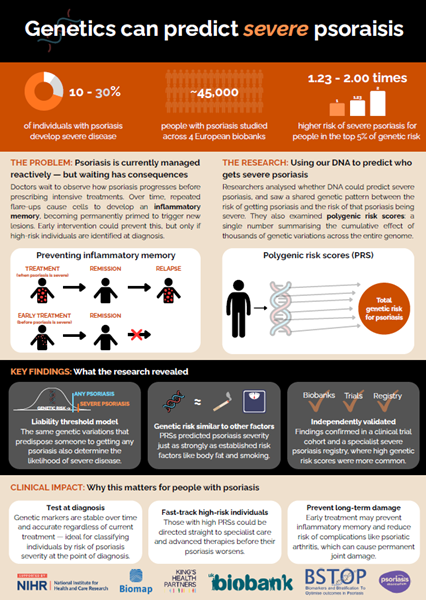
Approximately 10-30% of people with psoriasis go on to develop ‘severe psoriasis’ which is defined as ‘covering more than 10% of the body's surface’ and is linked to a higher risk of other health complications.
What was the study trying to find?
Currently, doctors wait to observe how psoriasis can progress over time before prescribing intensive treatments – which means that mild psoriasis gets weaker treatments, and stronger treatments are recommended when severe psoriasis develops. This is often referred to by the NHS as a ‘psoriasis treatment pathway’.
However, a downside to this approach is that the skin's natural immunity is shifted when psoriasis is left to progress and worsen, making treatments less effective.
 Click to enlarge
To prevent this, the study aimed to:
- Establish whether DNA could be used to identify those that are higher risk for severe psoriasis - so that they can access specialist care earlier, instead of waiting for the condition to progress to ‘severe’.
- Analyse ‘polygenic risk scores’ (PRS) - a number that summarises the combined effect of thousands of small genetic variations across a person's entire genome, to see if this could also be used in predicting psoriasis and it’s severity.
Key finding 1 – The genetic variations that determine someone having any psoriasis can also determine severity
More specifically, those in the top 5% of genetic risk were up to 2x more likely to have severe psoriasis than the average person with psoriasis.
What it means: Genetic markers are ideal clinical diagnostic tools because they are stable over time, cost-effective to test, and remain accurate regardless of someone’s current treatment or other health conditions.
Key finding 2 - PRS is effective in predicting the severity of psoriasis
It was found to be just as effective as considering other lifestyle risk factors, such as body fat and smoking.
What it means: In future, healthcare providers could use PRS to classify individuals by risk of psoriasis severity at the point of diagnosis, before their condition worsens. This would allow doctors to fast-track high-risk individuals toward specialist care and advanced therapies, potentially preventing years of physical discomfort and life-altering complications.
To find out more about the study, you can read the full research paper online.
Our commitment to furthering research
Our goal is to better understand what causes psoriasis, improve how it’s treated and managed, and ultimately find a cure.
To find out more, visit the research section of our website or take a look at our 2025-2030 research strategy.