Hattie's Story
Having lived with psoriasis for over 11 years, Hattie shares how her condition has changed over time and the ways she’s learned to adapt.
Psoriasis has been part of my life for over eleven years. It runs in my family, so when it first appeared in 2015, I recognised it from having seen different versions in relatives before me. It began on my scalp during a period of significant family illness and after I had been admitted to hospital with sepsis. Not long after the scalp patches appeared, a small patch developed on my side. That patch has since grown to over 20cm.
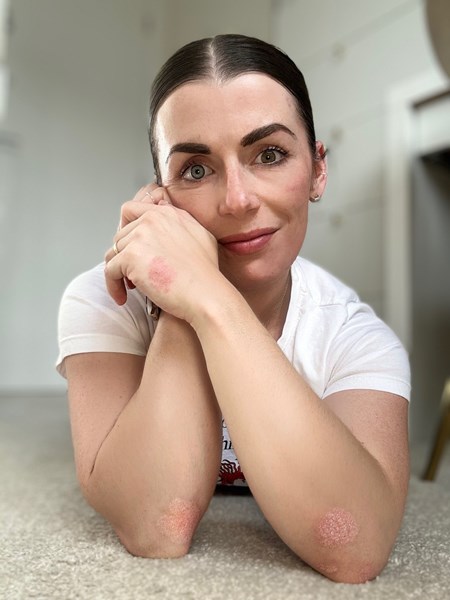 Click to enlarge
Over time, my psoriasis has progressed and changed. I developed plaques in new areas and began experiencing Koebner’s phenomenon, where even minor skin trauma would trigger further lesions. A scratch, friction, or blister could sometimes be followed by a new plaque days later. It has required a level of awareness I did not initially anticipate.
My nails have been significantly affected. They are brittle, lifted, frequently painful and often have bleeding underneath. I find the nail psoriasis can be particularly difficult because our hands are constantly in use — typing, washing, fastening buttons, holding things — and discomfort becomes part of every touch and task. Teaching myself to apply nail polish started as a practical way to add protection and reduce some of that sensitivity. Over time, the skill has become something creative and joyful.
I have been under dermatology care on several occasions and have tried a range of topical treatments. Each has helped to a degree, but the most I have ever achieved is “manageable.” In 2025 I completed ten weeks of phototherapy. There was noticeable improvement during treatment, but within two weeks of finishing, the plaques began to return. That experience reinforced something I had already come to understand: psoriasis can improve, but it can also reassert itself quickly. There is not always a fixed endpoint.
I have noticed a consistent pattern where periods of physical or emotional stress are followed by a flare. That might be a stressful life event or even a cold/viral illness. It has made me so aware of how closely my skin can reflect what is happening elsewhere in my body. Now, taking care of myself in any way I can has become a big focus of my wellbeing and management.
I would not choose to have psoriasis. It can be tight, itchy, often frustrating and uncomfortable. But over the years my approach has shifted from trying to eliminate it entirely to focusing on managing it as consistently as possible.
 Click to enlarge
There have been some unexpected positive consequences however; Learning to do my own nails began as a practical way to protect painful nail beds. It has since become a skill I value, and one that makes living with nail psoriasis easier. More broadly, living with psoriasis has strengthened my understanding of what others with chronic skin conditions experience. It has offered me a new perspective and ideas on how to support others.
I know that my experience is only one version of psoriasis. It presents differently in others — sometimes milder, sometimes more severe, with different patterns, triggers and responses to treatment. I understand that psoriasis does not follow a single path and its course can be unpredictable. Mine has evolved, and it may continue to do so. For many of us, the unifying experience is not just how it looks or appears, but instead how we learn to manage what is in front of us — adjusting, responding and carrying on.
Rachel
Rachel shares her journey with psoriasis including, at one point, relocating to the other side of the world to try and find some relief.
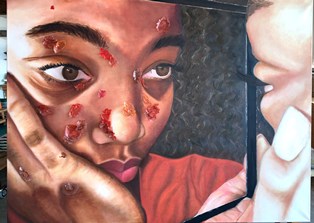
Vanessa
Vanessa has lived with psoriasis since she was a teenager, but her diagnosis of psoriatic arthritis was not easy. In her story, she talks about the pain she experienced before finally finding a treatment that worked for her.

Ellena
Having lived with scalp psoriasis since she was a child, Ellena shares how her condition has shaped her life, the challenges she’s faced, and how she’s learned to adapt as a mum of three.
Vicky
After developing severe psoriatic arthritis and multiple health challenges, Vicky’s life changed dramatically. Despite everything, she finds strength in her family and joy in life’s small, precious moments.